How it works
You build a program once. It runs itself for every cohort after that. Here is the whole shape of it, including the parts you set up yourself.
Step one
Set yourself up.
Your details, the support address your participants should use, the name you want on the emails and where replies should go, and the name you want your AI coach to answer to. Then a test run of your own, so you have seen every screen a participant will see.
About twenty minutes, once, ever.
Step two
Build a program.
Every program runs four weeks, because that is the optimal length for maximum participation and the greatest accountability value. Start from a template and edit it, or write your own questions. Once it exists it is yours: you can duplicate it for your next client and change a few details to customize it for them.
About twenty minutes the first time. Minutes for the second client.
Step three
Run the event and get people in.
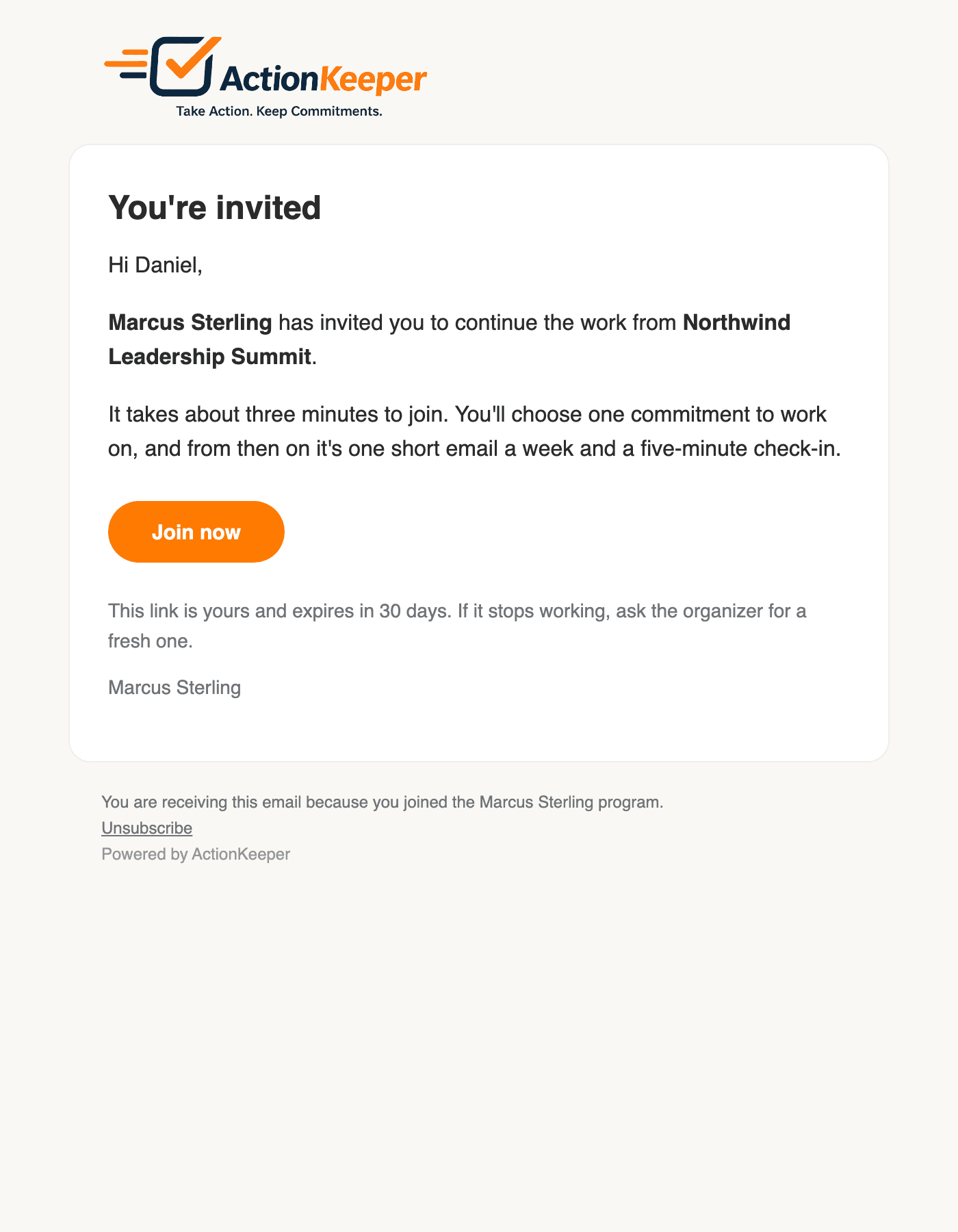
Every cohort receives a QR code by the system and an open registration link. You put the code on the closing slide and people join from their seats without you having collected a single email address in advance. You can also invite people individually or through an email list via CSV.
This is your opportunity to build in verbal and written commitment for action, accountability, and impact.
It takes two to three minutes near the end of your program. Thank them for their commitment and end your program with a strong conclusion or story.
Step four
They commit, in writing.
Not a vague intention. Each person writes down what they are going to do, and then the first specific action they will take toward it. The action is what does the work. A commitment like "be a better listener" is a wish, and nobody can say on Friday whether it happened. An action like "ask three questions before offering an opinion in Thursday's meeting" either happened or it did not, and that is what the weekly check-ins hold them to.

Step five
The weeks run without you.
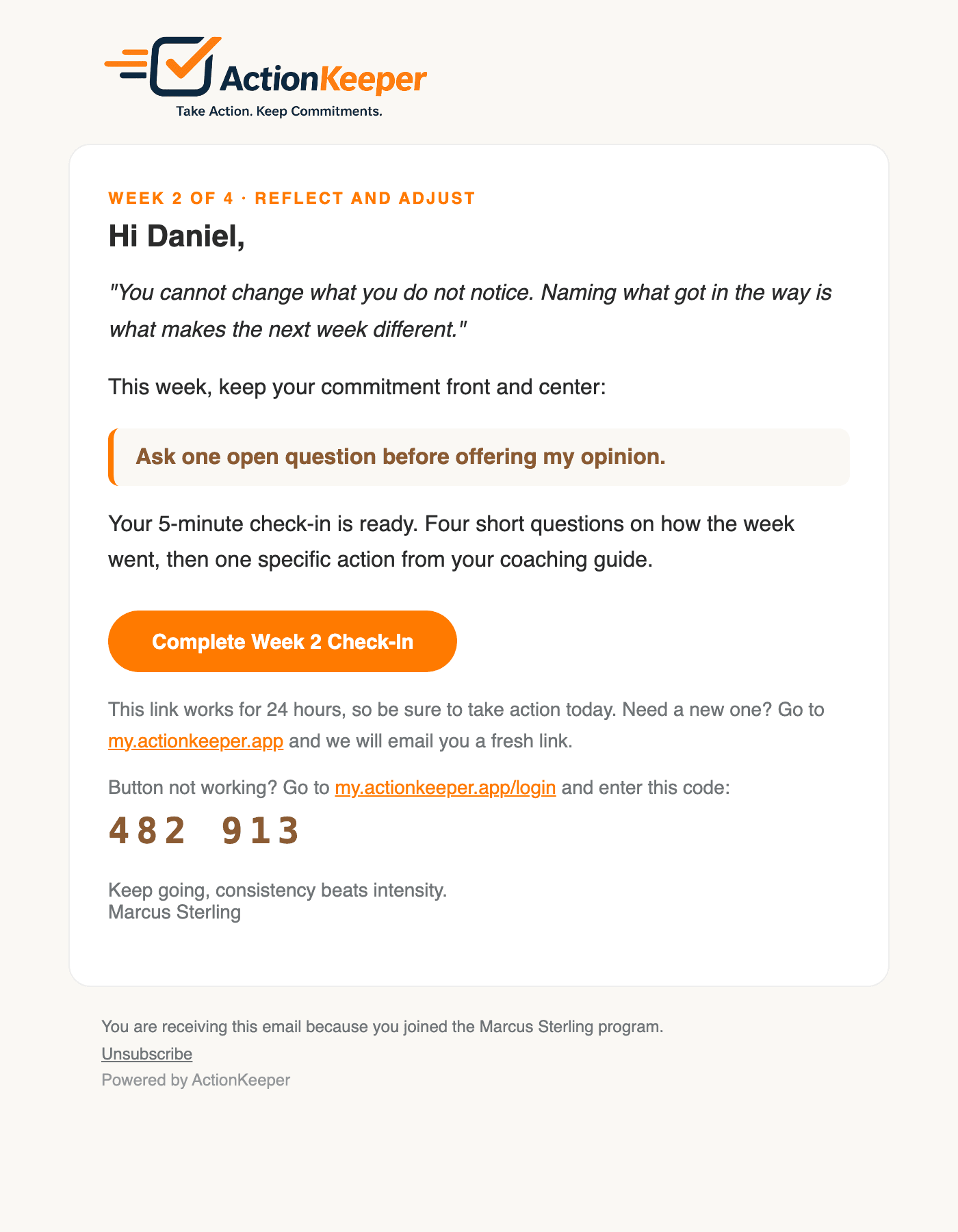
Each week an email goes out under your name asking how it went. The check-in takes about five minutes: what they did, what helped or got in the way, what changed, what is next. If someone does not answer after 48 hours, an email nudge follows.
None of your time at all, unless you want to look.
Step six
The coach turns an answer into an action.
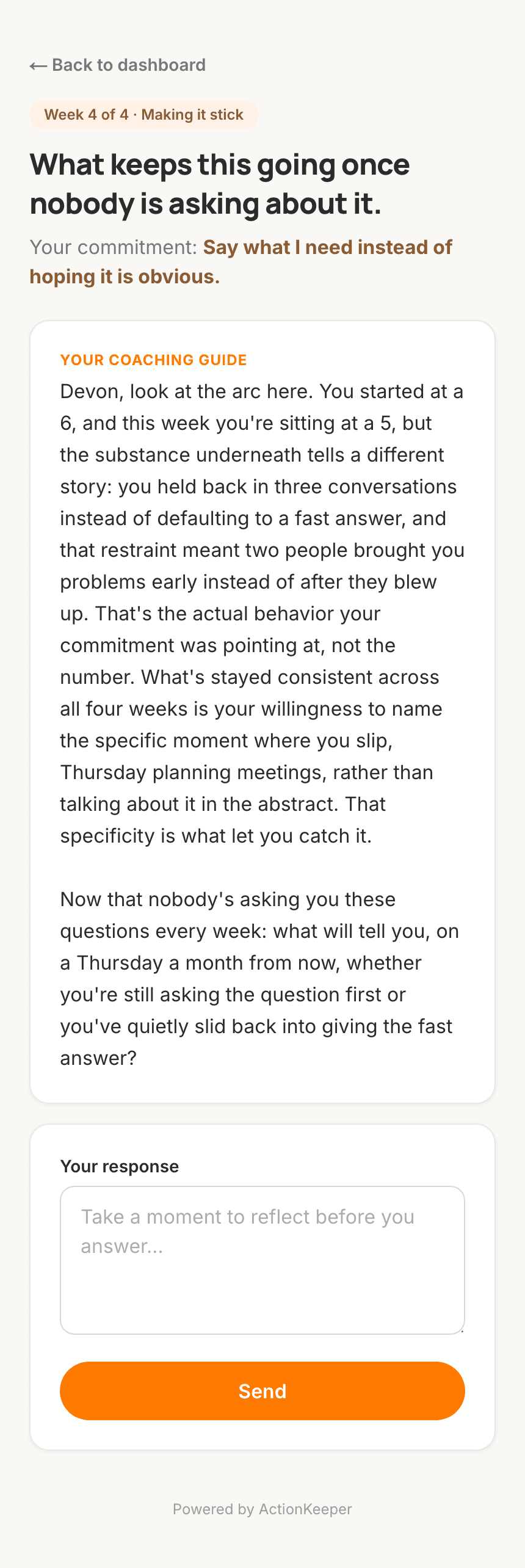
The coaching happens inside the weekly check-in. The participant writes what they did and what got in the way, the coach responds to that, and they go one more round to arrive at a specific next action. It answers in the name you gave it, and it works from two things only: the program you built, and what this participant wrote about their own commitment.
This is deliberately bounded. It is one focused exchange a week on the program in front of them, not a chatbot they can open whenever they like. That keeps the coaching on the commitment rather than wandering, and it is why the cost of running a cohort is predictable.
The coaching method comes from behavioral and performance psychology, drawn from Dr. Jason Jones’ published work and the established research behind it. How a commitment becomes a habit, what sustains motivation, how to size the next step so it survives a bad week. It supplies the method, not expertise in your subject, and it does not pretend otherwise.
Your AI coach…
- Says when it does not know, instead of guessing
- Does not present itself as a person
- Never gives medical, legal, or crisis advice
- Never sees another provider's participants or programs
Research it draws on
- Implementation intentions. If-then plans roughly double follow-through on a stated goal.Gollwitzer, American Psychologist, 1999
- The forgetting curve. Most new learning fades within days unless it is revisited.Murre & Dros, PLOS ONE, 2015
- Written goals and weekly accountability. 76% achievement against 43%.Matthews, Dominican University of California
Step seven
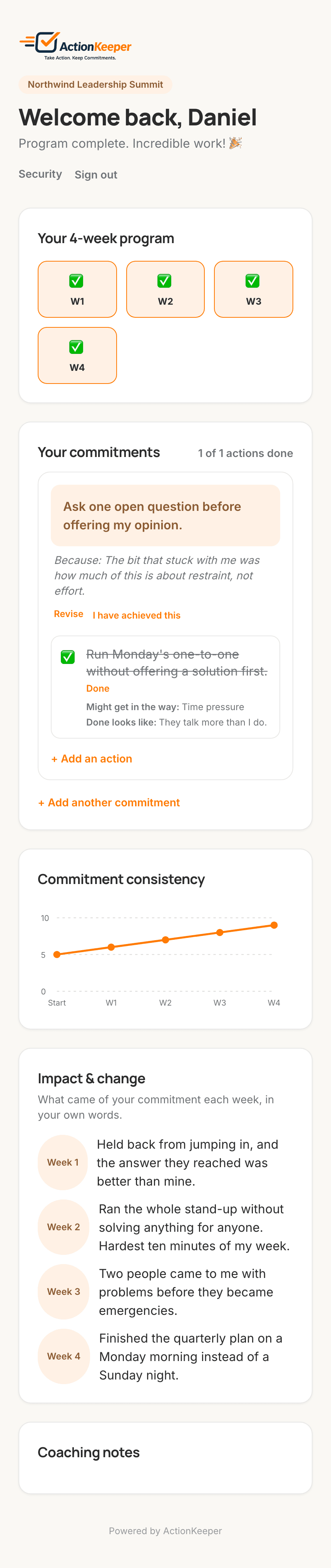
Everyone gets a dashboard to track progress.
ActionKeeper provides three dashboards, made for three specific roles.
1. The participant
A personal dashboard that shows their commitment, their actions, their self-reported progress week by week, and a rundown of their coaching interactions. It is the phone screen in step five, and it is theirs alone.
2. The sponsor
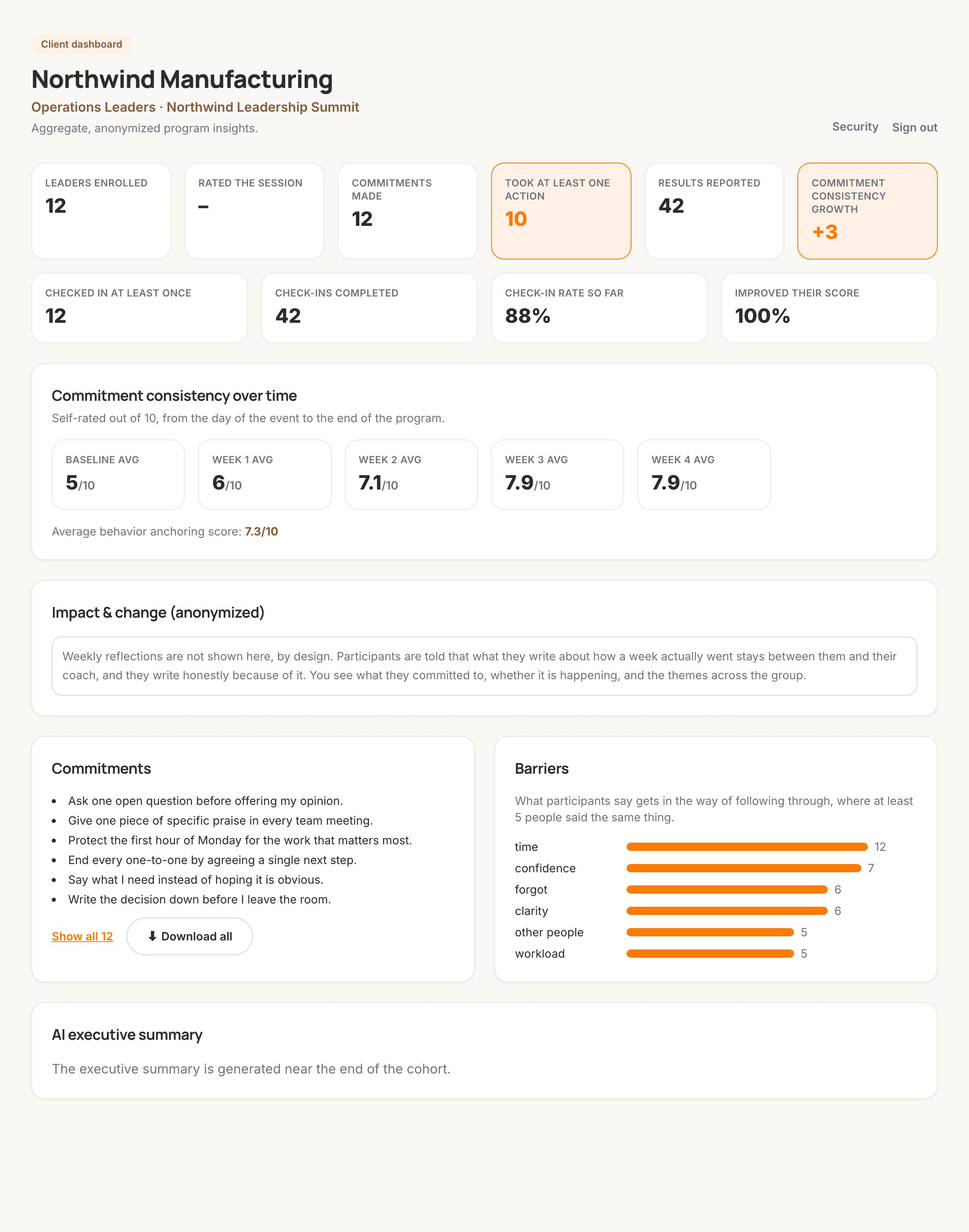
This is the person who booked you. They sign in to their own dashboard and see the outcomes for their people with none of the names: how many enrolled, how many committed, how many took at least one action, the check-in rate, how the scores moved from the day of the event, the barriers that came up most, and the list of commitments the group made. At the end, an executive summary and a CSV of everything, so it can go into whatever they already report in.
3. The provider
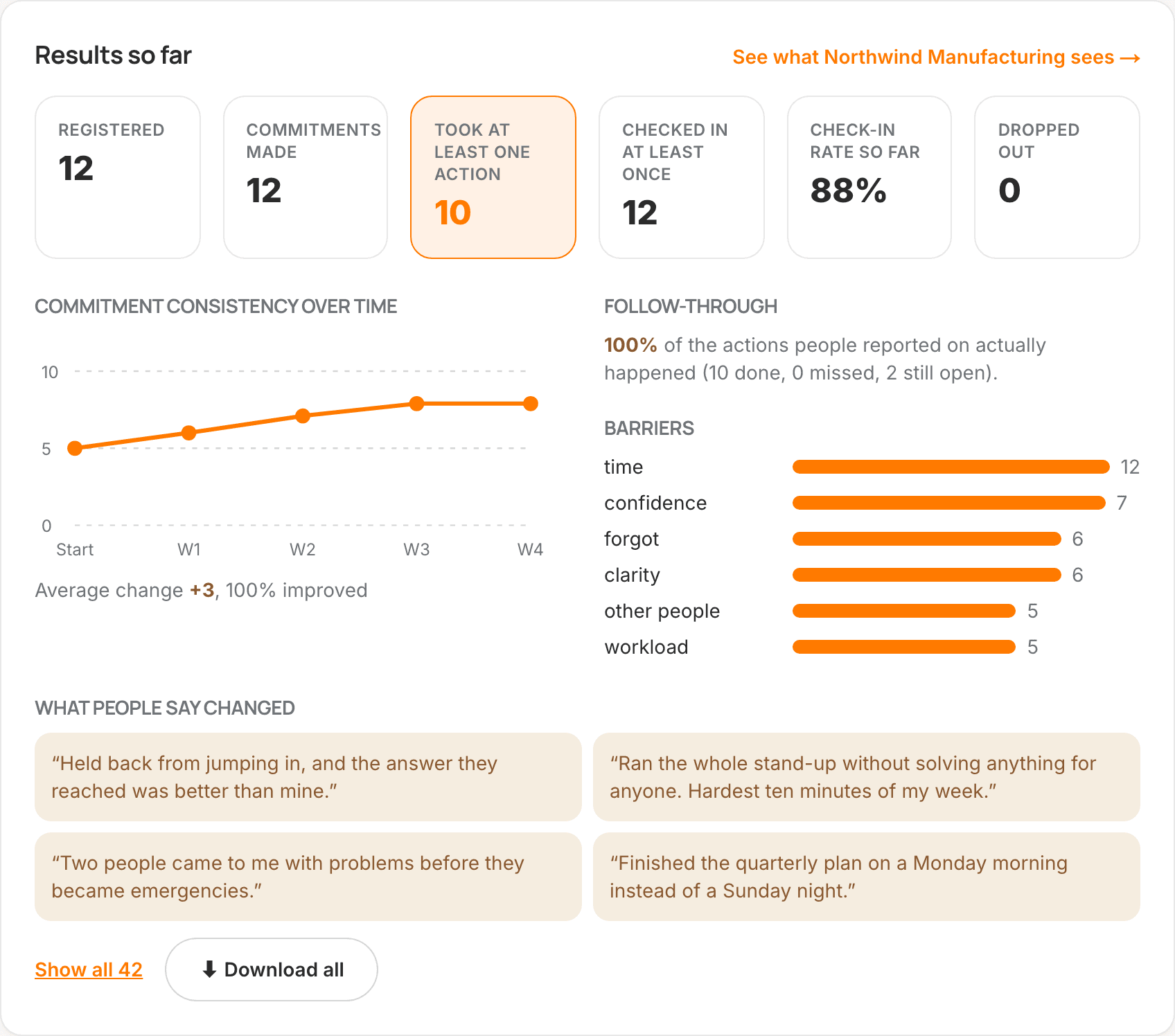
That is you. You open a cohort and see who registered, who committed, who took at least one action, the check-in rate, how the scores moved, what got in the way most often, and what people say changed. Across your practice you see every client, every cohort, and every program in one place.
Individual reflections are in none of the sponsor's view. Aggregate reporting is what makes people honest in the check-ins, and honest check-ins are what makes the report worth reading. Below five people a sponsor sees counts and scores and no free text at all.
Before anyone sees it
Run yourself through it first.
Enroll yourself as a test participant and walk the whole thing: the invitation, the commitment form, a check-in, the coach, the emails as they will actually arrive. Test runs never count against your plan's participant places.
Nobody should put a QR code in front of three hundred people having never seen what happens next, and this is how you avoid that.
That is the whole product.
If it sounds like something your clients would value, pick a plan and build your first program.